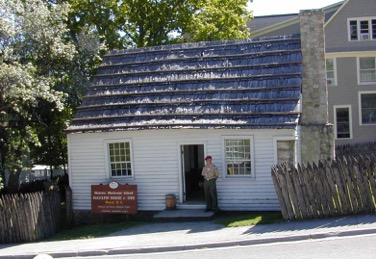
The McGulpin House is a gable-roofed French Canadian “pièce sur pièce, à queue d`ronde” (squared horizontal logs with dovetail corners) structure. It was moved from its east-end location behind Ste. Anne’s (“Lot 14”) to its present location in 1982. Based on its construction techniques, it is clear that the house was probably built around 1780, when Mackinac Island was first settled. It may even have been a house dismantled and moved to the island from Fort Michilimackinac at that time.
Origins of the House
Early land records suggest that there was a dwelling on Lot 14 owned by Charles Chandonet built prior to 1796. An 1805 map by Robert Dickson shows a dwelling on the property. The property was sold to Dr. David Mitchell in about 1808 who sold it to William McGulpin in 1817.
The McGulpin Family
William was the son of Patrick McGulpin and Mary Magdelene Crequi. Patrick, a native of Glasgow, Scotland, emigrated to North America in 1776 and eventually settled in Detroit, where he worked as a tailor. William, born in Detroit in 1791, was baptized into his mother’s Roman Catholic faith in 1793. A few years later, the family moved north to Mackinac Island. William grew up on the island. He married Madeleine Bourassa in 1815. For at least part of his life, William McGulpin worked as baker for the American Fur Company. He was also an active member of Ste. Anne’s Church, serving as a warden for several years.
Later History
The McGulpin family owned the property for more than sixty-two years. The west portion, noted above, was eventually torn down and a small addition was added to the east end. It passed through several owners after the 1870s, but remained an occupied dwelling until the 1970s.
The building was acquired by the Mackinac Island State Park Commission in 1982 with the condition that it be moved. A new site was found on a vacant lot at Market and Fort Streets, opposite the Beaumont Museum. All the later additions were removed and only the original log portion was moved to the new site. After moving it was carefully restored with the help of Mackinac Associates.
McGulpin House
Mackinac State Historic Parks
Mackinac Island, MI 49757
906-847-3328
<>
Visit Historic Mackinac Island Downtown Website >>>>
<>
[gmap name=’mcgulpinhouse’ lat=’45.850554′ lng=’-84.617244′ zoom=’16’ width=’580′ height=’380′ desc=’
McGulpin House
Mackinac State Historic Parks
Mackinac Island, MI 49757
906-847-3328
Visit Website‘]
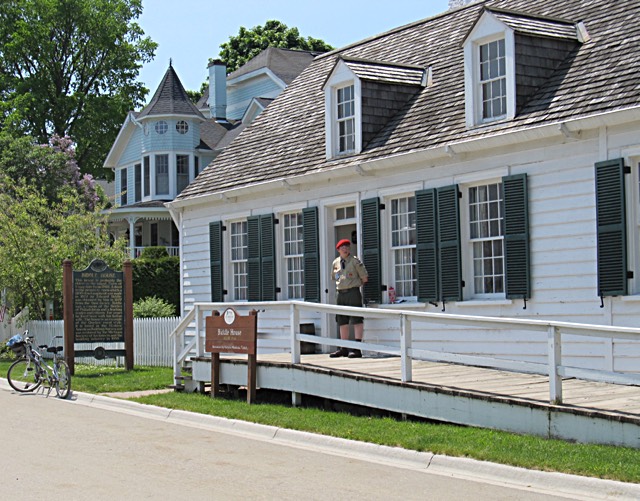
The exact date of construction of the Biddle House is not known. The lot was first owned by John Ogilvy, briefly sold to John Campbell, and then to Robert Dickson. The building is first documented in 1797, but may date to as early as the 1780s. A one and a half story, gable-roofed structure, it originally consisted of the current west portion (central hall with flanking rooms and a rear kitchen addition). It is of French Canadian “pièce sur pièce” construction (grooved upright posts with horizontal board infill). The house was purchased by Edward Biddle from Robert Dickson 1831. It is possible the Biddle family had rented the house as early 1822. The Biddles later added the east portion of the house and covered the exterior with clapboards. The interior of the main wing of the house featured fully plastered walls and molded woodwork. This also likely occurred during the Biddle remodeling.
Biddle, a fur trader, settled on the island after the War of 1812. Biddle’s grandfather, William Biddle III, had settled in Philadelphia in 1730, where his father, John Biddle, was born in 1736. John, a British loyalist during the American Revolution, moved to Nova Scotia following the revolution. Edward was born there in the 1790s. In 1819 Edward married island resident Agatha de LaVigne, a young Métis woman of mixed Odawa and French Canadian ancestry. Biddle was involved in the fur trade, business ventures, and politics on the island. As an independent fur trader Edward acted as a middleman, buying furs from local tribes and trappers and selling them to fur companies. He partnered with people like John Drew and William Mitchell in business dealings and held many offices on the island.
Biddle House
Mackinac State Historic Parks
Mackinac Island, MI 49757
906-847-3328
<>
Visit Historic Mackinac Island Downtown Website >>>>
<>
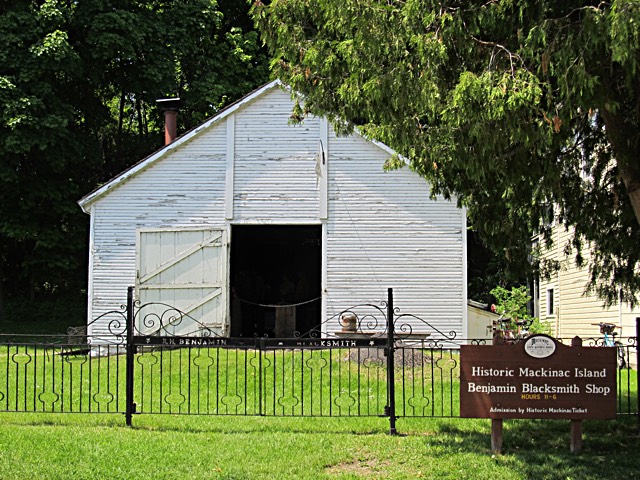
The Benjamin Blacksmith Shop was located on the west end of Market Street (just past Cadotte Avenue, on the south side on “Benjamin Hill.”). Originally known as “Star Blacksmith Shop,” it was sold by William Jackson to Robert Benjamin and Frank Cummins in 1885. In 1900 Robert’s sixteen year old son Herbert took over operation of the shop when Robert was elected Mackinac County sheriff and moved to St. Ignace. Herbert continued to offer the variety of services his father had, including the repair of iron objects, small manufacturing jobs, shoeing horses, and repairing carriages.
By the middle 20th century his services had expanded to that of a small machine shop with the repair of yacht motors and lawn mowers. As autos had been banned on the island by the turn of the twentieth century, shoeing horses always remained part of the operation. Herbert ran the shop until 1965.
In 1968 the shop and its vast array of contents were donated to the Park Commission by Herbert’s family. There was one proviso: The shop building had to be removed from its site at the western end of Market Street. The commission accepted the offer, and selected a new site on the east part of the Biddle House lot. Assistant Director Dr. David Armour and Staff Archaeologist Lyle M. Stone carefully documented the building and its contents during the winter of 1968. The new site was smaller than the original, so only about two thirds of the blacksmith shop could be recontructed. Floorboards, windows, and other pieces were salvaged and used in the reconstruction, and all the objects were put back in approrpriate places. The shop opened to the public in 1970.
Benjamin Blacksmith Shop
Mackinac State Historic Parks
Mackinac Island, MI 49757
906-847-3328
<>
Visit Historic Mackinac Island Downtown Website >>>>
<>

The Straits of Mackinac was a center of the fur trade from the late 1680s. Beginning in 1815 activity was centered in John Jacob Astor’s American Fur Company (AFC). The company agent’s home, clerks’ quarters and warehouse were located at the center of Market Street. There furs were processed and trade goods assembled.
The Retail Store was established by the company in about 1820 on the corner of Market and Fort Streets as an outlet where the company could sell surplus merchandise. Company employees, community residents and Fort Mackinac soldiers shopped here. It was one of several general stores that served Mackinac Island in the 1820s and 1830s.
On this site in 1822 Alexis St. Martin, a voyageur, was injured by an accidental gunshot wound. The unusual healing of the wound allowed Dr. William Beaumont, Fort Mackinac’s post surgeon, to conduct experiments on how the human stomach worked.
American Fur Company Store & Dr. Beaumont Museum
Mackinac State Historic Parks
Mackinac Island, MI 49757
906-847-3328
<>
Visit American Fur Company Store & Dr. Beaumont Museum Website >>>>
<>
[gmap name=’americanfur’ lat=’45.850613′ lng=’-84.617692′ zoom=’15’ width=’580′ height=’380′ desc=’
American Fur Company Store & Dr. Beaumont Museum
Mackinac State Historic Parks
Mackinac Island, MI 49757
906-847-3328
Visit Website‘]
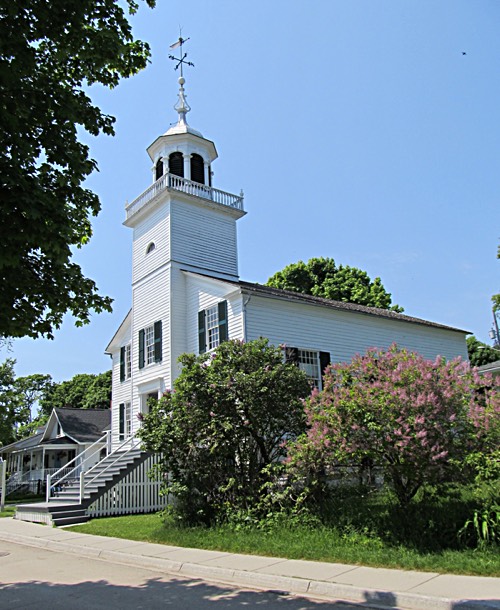
Mission Church has been restored to its 1830’s appearance. Walk up and down the aisles and see the restored church in its 1830’s-era glory. Open a pew door and sit inside, enjoying the peace and quiet of a church from the past. Each family had their own pew, as evident when entering this church, and for a moment that space could be yours.
History
Evangelical Protestants built the New England style Mission Church during 1829 and 1830 to house the Presbyterian Congregation on Mackinac Island. The church was led by Reverend William Ferry and his wife Amanda, who were missionaries with the American Board of Commissioners for Foreign Mission. Many prominent island residents involved in the fur trade attended the church, including Robert Stuart and Henry Schoolcraft.
Mission Church
Mackinac Island, MI 49757
<>
Visit Historic Mackinac Island Downtown Website >>>>
<>
[gmap name=’missionchurch’ lat=’45.849836′ lng=’-84.608770′ zoom=’15’ width=’580′ height=’380′ desc=’
Mission Church
Mackinac Island, MI 49757
Visit Website‘]